Showing posts with label equities trading tips. Show all posts

Monday, 16 July 2018

What Strategies do Millionaire Investors follow?

While there are various procedures that have been effectively utilized by financial investors in a scope of records, for example, the S&P 500 and the FTSE 100, here are three that could be simple for any investors to embrace. Given the stock tips that they have worked in the past for exceedingly fruitful investors, they can possibly support your portfolio returns over the long period of time.


What Strategies do Millionaire Investors follow?


Know your Investments- 

Peter Lynch conveyed a 29% annualized come back from 1977 to 1990, with his Fidelity Magellan subsidize effortlessly beating the S&P 500. One of the key parts of Lynch's contributing style is to dependably know the organizations in your portfolio. For instance, regardless of whether a stock is by all accounts shoddy and has a solid asset report, seeing how it produces a benefit stays key from a venture point of view.

This stock investment tip may seem like basic counsel, however, it could assist financial investors with avoiding making significant mistakes when purchasing and selling shares. At last, there are dependably hazards with regards to investing, yet limiting them through having an exhaustive comprehension of the stocks in your portfolio could enhance the general hazard/compensate opportunity on offer.

Investment in smaller companies- 

While putting resources into real files, for example, the S&P 500 or FTSE 100 can offer ideal hazard/remunerate openings, small sized organizations can convey higher returns. That is the reason Jim Slater could produce great returns amid his speculation vocation, with his emphasis on profit development and valuation supplementing an inclination for small sized organizations.

Apparently, smaller stocks can be less secure than their bigger partners. They frequently have accounting reports that are less steady, while the departure of a key contract or client can prompt more prominent money related agony in the short run. What's more, with them for the most part being centered around a smaller geographical zone, they may do not have the assorted variety of their bigger associates.

In the meantime, however, little organizations can convey higher benefit development. They may likewise turn out to be all the more exceptionally appraised on the off chance that they can offer financial specialists the guarantee of solid primary concern increments over the long haul. Accordingly, for less hazard disinclined speculators, they could be of intrigue.

Moral organizations- 

While moral contributing may not be a conspicuous decision for some financial specialists, Charlie Munger is an advocate of the thought. He trusts that a decent business is a moral business, and this could imply that financial specialists should concentrate more on corporate administration in future. All things considered, an organization with exclusive requirements of administration might be less dangerous than a stock that is less clear with its execution and standpoint.


Trading tips


While ethical investing may not be an obvious choice for many investors, Charlie Munger is a proponent of the idea. He believes that a good business is an ethical business, and this could mean that investors should focus more on corporate governance in future. After all, a company with high standards of governance may be less risky than a stock that is less clear with its performance and outlook.

So millionaire investors follow the above-mentioned strategies, Hope this article was helpful to you! Keep up to date with our Singapore stock blog for receiving best Singapore stocks investment and stock signals.


Leave a feedback in the comment section. Thank you for reading!

Friday, 25 May 2018

Singapore stocks to watch -Bukit Sembawang Estates, RHT Health Trust, Singapore Shipping Corp, SingHaiyi,


Below, I'll feature these best stock picks of Singapore which are profit payers that you should add these Singapore stocks to your watchlist.


SGX Stock picks
SGX Stock picks


Bukit Sembawang Estates: Property engineer Bukit Sembawang Estates revealed a generous increment in quarterly net salary on Thursday, as it perceived higher benefits from its improvement ventures. Net benefit after duty expanded to $21.5 million in the final quarter finished March 31, from $2.3 million the prior year. EPS came in at 8.3 pennies, from 0.87 pence a year ago. In the interim, income dramatically increased to $32.8 million in Q4 FY18. The organization has pronounced the last profit of four pennies for every offer, and an extraordinary profit of 14 pennies for every offer for FY18. The counter shut at $6.17 each on Thursday, up 0.5 for every penny.

RHT Health Trust: RHT Health Trust recorded 5.4 for each penny bring down circulation per unit to 1.06 Singapore pennies for its monetary final quarter from a year prior. Add up to distributable salary for Q4 2018 was $8.6 million contrasted with $9.05 million a year ago. This was because of an expansion in borrowings and an expansion in loan fees, which prompted higher intrigue costs, RHT said. Income for the quarter was up 2.5 for each penny to $23.13 million. The counter finished exchanging at 78.5 pennies on Thursday, down 0.63 for each penny.

Singapore Shipping Corp (SSC): Listed shipowner and chief SSC posted a 59.5 for every penny increment in final quarter net benefit to U$2.57 million on higher income and working benefit. EPS were 0.6 US penny for the quarter finished March 31, contrasted with 0.4 pence for the year-back period. Final quarter income was 10.4 for every penny higher at U$11.36 million, fundamentally on higher business volume from the organization and coordination portion. SSC shut down at 28 pennies on Thursday, down 0.5 pence.

SingHaiyi Group: The higher cost of offers and the nonattendance of a coincidental pick up in the past period scratched land organization SingHaiyi's financial final quarter benefit, which fell 70.7 for each penny to $6.5 million from a year prior. Profit per share (EPS) were down to 0.21 penny from 0.77 pence. SingHaiyi's board has proclaimed the last profit of 0.3 pence. Income for Q4 rose to $27.51 million contrasted with $8.19 million in the former year. The counter shut down at 9.6 pennies on Thursday, up 1.05 for every penny.


Wednesday, 25 October 2017

Good time to BUY Wing Tai Holdings Ltd

  • 1QFY18 results in line
  • In net cash position
  • FV estimate increased to S$2.77

1QFY18 PATMI up YoY From S$1.1m to S$8.2m

http://www.mmfsolutions.sg

Wing Tai’s 1QFY18 PATMI increased from S$1.1m to S$8.2m YoY mainly due to contributions from Le Nouvel Ardmore, Le Nouvel KLCC as well as disposal gains on the Huai Hai project in Shanghai. In addition, we also saw the group’s share of profits of associated and joint venture companies increased 17% YoY to S$6.7m given higher contributions from Wing Tai Properties Ltd in Hong Kong.

In terms of the topline, however, 1QFY18 revenues decreased 4% YoY to S$67.1m as the group recorded lower homes sales over the quarter. Overall, we judge 1QFY18 results to be broadly within expectations.

Fair Value Estimate Increased to S$2.77; Maintain BUY

To recap, in Aug 2017, the group together with Keppel Land acquired through a government land sales tender a 99-year leasehold residential site in Serangoon North Ave 1. The site, which has a gross floor area of 462,561 square feet in the Serangoon Gardens area, will be redeveloped into a new condominium development with over 600 homes.
As at end Sep 2017, Wing Tai continues to sit on a strong balance sheet in a net cash position with over S$1,011m in cash and equivalents. We now forecast for Singapore home prices to appreciate 1% in 2017 and 3% to 8% in 2018 and, given the group’s ample dry powder, we believe that Wing Tai is well positioned to benefit from the turnaround in the domestic housing sector.

Notwithstanding a 46% share price appreciation over the year to date, we see the group’s current price to be relatively undemanding at 0.57x price-to-book. After updating our valuation model with our latest assumptions and firmer average selling prices, our fair value estimate increases from S$2.37 to S$2.77. Maintain BUY.

Monday, 16 October 2017

Singapore Market review of the day

SINGAPORE - After two weeks of solid gains in the stock market that sent the benchmark Straits Times Index (STI) up by nearly 100 points or 3.1 per cent to breach through the 3,300 level, what are the odds of a third week of gain?

Pretty good, analysts reckon, citing Singapore's strong economic footing and the relative underperformance of its Singapore Stock market against regional peers.

The Trade and Industry Ministry's advance estimates last Friday showed that the economy expanded 4.6 per cent - its fastest pace in more than three years - in the third quarter, buoyed by the surging manufacturing sector.

This beat economist forecasts of 3.8 per cent growth, and was also the fastest quarterly expansion since 2014.

The better-than-expected performance was lifted by a stellar showing in manufacturing, which surged 15.5 per cent year on year.

The sector makes up a fifth of the economy.

Services - which makes up two-thirds of the gross domestic product (GDP) and employs the bulk of workers - grew 2.6 per cent.

Bolstering the good share Investment news on the same day was a decision by the central bank to keep its exchange rate policy stance unchanged.

This means keeping the Singapore dollar band on a path of zero appreciation against the currencies of key trading partners.

This will be welcomed by local exporters who see a dearer Singapore dollar as being unhelpful in pricing their products competitively in the global market.

The Monetary Authority of Singapore uses the exchange rate as its main monetary policy tool to strike a balance between inflation from overseas and economic growth.

"Upbeat GDP readings and MAS policy decision sent the STI to its highest level in more than two months... STI has finished its two-month consolidation and is gaining upward momentum ahead of third-quarter earnings season," said CMC Markets Singapore analyst Margaret Yang.

She noted that the local index had underperformed regional peers over the last two months, with its performance lagging behind major indices S&P and Hang Seng.

The STI ended last week up 0.8 per cent at 3,319.11, a key level that Ms Yang has noted.

"3,300 point is a psychological and technical resistance level for the STI. Breaking out above this critical point will pave way for more upside towards the previous highs of 3,354 points."

With the results season kicking in, good corporate earnings will help to boost confidence and attract more liquidity into Singapore, she added.

DBS Group Research noted that corporate earnings growth in Singapore is recovering after two years of negative growth in 2015 and 2016.

It believes earnings growth should continue to be healthy, driven by a decent economic recovery with upside risk.

"We believe STI could attempt to hit 3,500 by end-2018, representing around 10 per cent total return inclusive of dividends."

The Keppel group of companies will report their third quarter results this week, starting with Keppel DC Reit and Keppel Infrastructure Trust on Monday and ending with Keppel Corporation on Thursday.

This week and next appear to be a popular reporting period among the Reits, with no fewer than 19 indicating that they will release their results.

Singapore Property stocks, which have enjoyed a surge of price and volume, are likely to remain in play.

The release on Oct 16 of new private home sales for September may give further fillip to the share price of developers if the sales figures are as strong as the spate of collective sales that have hit the market.

Last Friday, City Developments closed at $12.66, its highest level in nearly five years while UOL ended at a record $8.89.

Both companies snared a residential site each in the sought after East Coast area through collective sales recently.

Singapore Stocks To Watch

  • AEM
  • ALLIANCE MINERAL
  • COMPACT METAL
  • ROWSLEY
  • THAIBEV
So Earn more With our Stock Recommendations

Recent Stock Recommendations

SGX:Buy ALLIANCE MINERAL || Level 0.360|| Cut Profit @ 0.395 || Return 9.72%
KLSE:Buy DNONCE || Level 0.405 || Cut Profit @ 0.440 || Return 8.64% 


Saturday, 14 October 2017

How to Pick best dividend stocks Singapore

As investors, we all love dividends. Other than the thrill of seeing a stock you own rise higher and higher in the Malaysia / Singapore stock market, receiving passive dividend income from your investments every year is something we all look forward to.


How to Pick best dividend stocks Singapore www.mmfsolutions.sg
So if you’re more of an income investor and looking to invest for dividends, your stock portfolio will be markedly different from someone who’s investing for high growth and capital gain. The stocks that will give good, consistent dividends may not necessarily be the kind that will grow by 20-50% a year and vice versa.

So if you investing for dividends, you have to invest accordingly and only pick the best stocks that will give the passive dividend income you want. The question is: How?

So if you’re slightly lost and looking for some direction, here are 7 quick steps to help you pick the best dividend stocks around: 


1 .Look for Mid-Large Cap Stocks


The best dividend stocks are usually large, mature companies with stable revenue, profits and cash flow. These companies have little growth left in them. Because these companies are no longer expanding aggressively, the majority of their earnings can be returned to shareholders as dividends.

On the other hand, a smaller, high-growth company needs more cash and resources to grow and expand its business, leaving less money to pay shareholders dividends (if any).

2 .Dividend Payout Ratio is 50% or More


If a company is large, stable and isn’t seeking to grow aggressively any more, then the majority of the profits it makes should be returned to shareholders. So look for a company with a dividend payout ratio of at least 50% or more. For example, Nestlé (Malaysia) returns over 90% of its earnings to shareholders as dividends.

If a company has a low payout ratio, ask yourself why the company is holding on to the cash. Unless they have a good reason to do so or have a way to generate exceptional returns for shareholders, the majority of profits should be paid out as dividends.


3 .Track Record of Paying Consistent Dividends


The company should have a long and stable track record of paying consistent/growing dividends to shareholders. No point if a company is large and successful and has profits to distribute as dividends, but chooses to pay them out inconsistently.

Check to see a company pay a consistently growing dividend over the last 5-10 years. This shows that as the company grows more and more successful, the management is also willing to share the fruits of its labour with its shareholders.

4 .Company’s Fundamentals Must Be Sustainable


Many dividend investors tend to ignore the overall aspects of a company’s fundamentals. They choose to focus primarily on the amount of dividends they can receive. This is wrong. While dividend yield is obviously important for someone seeking dividends, it is also important to consider the overall health of the company.

A company with deteriorating fundamentals (e.g. falling revenue, profits, cash flow, fading economic moat, etc.) cannot sustain its dividend payout in the long term. The less revenue and profit it makes, the less dividends it can pay.

Over time, a company with falling revenues and profits will see its stock price fall when investors realize that the company is no longer performing. This fall in value will eat into any dividend gains you might have had at the start – leaving you back at square one.

So always make sure the dividend company you want to invest in will remain fundamentally strong and robust for many years to come.

5 .Company has Low CAPEX


As a dividend investor, you prefer to invest in a company with low capital expenditure (CAPEX). A company with high CAPEX means that it has to continually reinvest its profits in maintaining its business operations, leaving less to distribute as dividends.

For example, airlines have very high CAPEX as they need to continually maintain their aircraft and upgrade them to newer models after a certain amount of years.

So look for a company that’s able to maintain/grow its business with minimal CAPEX.

If you want help, you can always kick start the idea by downloading our watchlist of dividend paying stocks below:

6 .Company has Stable Free Cash Flow


Ultimately, a company must have real cash (not just profits) to be able to pay dividends to its shareholders. Even if a company is profitable but has negative or inconsistent free cash flow, it will have trouble paying stable dividends.

A smaller company that is seeking to grow might have negative free cash flow as it expands its business. But a large, stable company that dominates its industry should be producing high amounts of free cash flow year after year.

7 .Yield Must Beat Risk-Free Rate


The dividend yield you receive should beat the risk-free rate of the country you reside in. The risk-free rate is the lowest return you can theoretically get “risk-free”over a period of time.

In the US, if you plan to invest your money for ten years, then the risk-free rate is usually based on the return of the 10-year US Treasury note which is currently around 2.30%. In Singapore, the risk-free rate is usually based on the interest your CPF special account gives you, which is 4%.

If your dividend yield can’t beat your risk-free rate, you might as well put your money with your CPF since you face less risk growing your money there compared to investing in stocks.


Get Perfect Plan for Blue Chip stocks , Intraday Trading Signals & Positional stocks Signals for SGX market

Source - fifthperson

Wednesday, 11 October 2017

Share Investment of Yoma Strategic Holdings

In the World Bank Group’s East Asia and Pacific Economic Update for October 2017, Myanmar was noted to have seen economic growth slowing to 5.9% in 2016/17 compared to 7% in 2015/16. However, economic growth is projected to recover to 6.4% in 2017/18 and average 6.9% over the medium-term.
 
Share Investment of Yoma Strategic Holdings www.mmfsolutions.sg


The report also noted that an expected bounce in agriculture activity is likely to support stronger growth in rural incomes moving forward, though productivity bottlenecks remain.
In our view, these set of forecasts should continue to support Yoma’s distribution and after-sales services for New Holland tractors. The World Bank Group also notes that consumer purchasing power in the country has also been rising. This also bodes well for Yoma’s KFC business, as the group is looking to increase its store count from 13 as of 30 Jun 2017 to 22 by the end of FY18.

Maintain HOLD with an unchanged fair value estimate of SS$0.58.


Thursday, 5 October 2017

Catch once REITs Share Investment

The price performance of Hospitality REITS during the past 1 year have been nothing short of incredible.

These REITS typically own and manage hotels, that are hand-picked for their prime location within major cities, in countries like Singapore, Melbourne and London. A good management helps to ensure a steady stream of repeat bookings from business and leisure travelers, and high occupancy rates allow for a steady stream of dividends that the REITs are able to distribute to unitholders.
SGX alone is home to 5 REIT listings that derive more than 60% of their rental income from hospitality real estate assets.

These 5 REITs have witnessed on average a 15% gain in share price alone. Coupled with average annual dividend yield of 5% to 6.6%, investors would have reaped a total of 20% gains on invested capital over the past 1 year.

Frasers Hospitality Trust


Frasers Hospitality Trust is one of the hospitality REITs contributing to the overall vibrancy of the Singapore REIT market. It is a pure play hospitality REIT with a service residence portfolio, and is globally diversified with 15 properties in 9 cities. Intercontinental Singapore is one of its local holdings, with Sofitel Sidney Wentworth and Park International London as part of its overseas hospitality assets. Its Q1 2017 DPS came 4.2% in lower as compared to previous corresponding quarter due to a rights issue which increased the number of units outstanding. Its growth engine is in full force from the recent acquisition of Novotel Melbourne and Maritim Hotel Dresden and investors can look to stronger performance recovery from its Singapore and Japan assets. It is currently offering the highest yield among all hospitality REITs at 6.6% per annum.
 

Ascendas Hospitality Trust

Ascendas Hospitality Trust is another global REIT with prime assets scattered over top cities such as Sydney, Melbourne, Beijing, Tokyo and Singapore. Most hotels owned by the REIT are located in Australia and are mid-grade hotels: Pullman and Mercure and Novotel Sydney. Diversification is the REITs key strategy to deliver strong unit-holder returns. Its share price has risen nearly 20% from the start of the year. Should its Australian hotel property suffer a drop in occupancy levels as a whole, the REIT could look to other regions such as its China and Singapore portfolio to deliver returns. Another attractive feature is that Ascendas Hospitality REIT owns 3 and 4 star hotel properties which give higher operating margins as compared to higher end hotels.
 
Read More- Which Singapore Stocks are Trending of This Week?

Far East Hospitality Trust

Far East Hospitality Trust has been going strong as well for the past 1 year. Investors looking for a localised REIT can look to this Singapore focused REIT where all its hotel portfolios are primarily located in the major shopping district of Singapore, such as Orchard Parade, The Elizabeth Hotel and The Quincy Hotel. Its Q2 2017 financials were weak as DPS recorded a decrease of 4% but investors should look past quarter on quarter fluctuations and project expected returns beyond 5 years. Its 6.19% annual yield still gives investors decent returns on investment and Singapore’s resilience in attracting global tourists and business traveller should bode well for this REIT.
 

CDL Hospitality Trust


For investors looking for exposure in the global tourism sector, CDL Hospitality Trust is the REIT that should fall under the investors’ radar. Its property portfolios are scattered all over the world in major cities from Tokyo to Perth with huge tourist arrivals business travellers every single year. CDL HTrust provides excellent geographical diversification, backed by world class hotels run by solid management team. Its Singapore portfolio makes up 58% of total property portfolio, with the remaining 42% strategically located in other major cities. It is always on the hunt for quality hospitality assets with the latest being the acquisition of The Lowry Hotel in Manchester. Its track record is backed by an attractive dividend yield of 5.95% per annum, making it one of the best REITs in Singapore. Its performance over the past year has been good as well, delivering nearly 20% gains in unit price alone.
 

OUE Hospitality Trust


OUE Hospitality Trust would also make an interesting REIT investment should investors want a Singapore pure play hospitality REIT, similar to Far East Hospitality Trust. Its property portfolio comprises 5 star hotels namely Crowne Plaza and Mandarin Orchard. Its dividend yield is one of the highest offered at 6.2%. Singapore tourist arrivals had been on a steady uptrend over the many years up till 2016 with the Singapore government constantly seeking new inputs to attract tourist dollars. The hotels are upscale hotels catering to well-heeled tourist whom are less price sensitive and values great top notch hospitality hotel service. OUE Hospitality is well positioned to reap solid occupancy from these tourist segments.
Source - ZUU online SG

Friday, 29 September 2017

Stock Market Analysis: Sponsor Actively Expanding Portfolio

  1. ‘BBB’ rating assigned by Fitch
  2. Gearing to increase to 36%
  3. Trading at 6.0% FY18F yield

Sponsor Actively Expanding Portfolio

The Ascott Limited, Ascott Residence Trust’s (ART) sponsor and a wholly-owned business unit of CapitaLand, has been actively growing its serviced residence (SR) portfolio globally and securing its market leadership in various geographies. Earlier this month, The Ascott announced the acquisition of a prime SR in the Jakarta CBD, further strengthening its position as the largest SR operator in Indonesia.

Stock Market Analysis: Sponsor Actively Expanding Portfolio - www.mmfsolutions.sg


Besides Indonesia, The Ascott is also the largest SR operator in five other SEA countries. This investment comes on the back of strategic moves in other regions: the acquisition of an 80% stake in Synergy Global Housing, a corporate housing provider in the US, and the increase of its stake in Quest Apartment Hotels from 20% to 80%, which makes The Ascott the largest serviced SR operator in Australasia.

'BBB' Rating Assigned by Fitch

Fitch Ratings has assigned ART a Long-Term Issuer Default Rating of 'BBB' with a Stable Outlook. Notably, in the analysis released by Fitch, ART's 'BBB' rating was compared to peers such as CDL Hospitality Trusts (CDLHT, BBB- /Stable), Host Hotels & Resorts, Inc. (Host Inc, BBB/Stable) and Mapletree Industrial Trust (MIT, BBB+/Stable). Despite CDLHT having a stronger financial profile, Fitch favours ART for its more geographically diversified portfolio and better cash flow visibility stemming from its long-stay tenants.

Gearing Expected to Come to ~36% Post AOS Acquisition

ART’s gearing as of 30 Jun 2017 was 32.4%, though this is expected to increase to 36% after the acquisition of DoubleTree by Hilton Hotel New York in Aug and that of Ascott Orchard Singapore expected next month. ART's unencumbered assets/unsecured debt ratio stood at 2.9x, substantially higher than the 2.0x ratio Fitch has identified as the minimum level for investment grade real estate investment trusts to support strong financing flexibility and limit the subordination of unsecured creditors' interests.

We continue to be positive on the geographical diversification of ART’s portfolio and the support of a strong sponsor, but believe the REIT could trade at a more attractive yield. Against yesterday’s closing price, ART is trading at 5.2% FY17F yield and 6.0% FY18F yield.

Maintain HOLD with a fair value of S$1.10.


More update:  Stocks To Watch, 2017 Stock Market Outlook, Stock Market Investing Outlook & Investment Outlook 2017

Saturday, 9 September 2017

Share Investment blogs of recent week

Stock picks for Singapore market solely depends upon the market scenario and investors take calls as per SGX stock market movements today.These stocks picks helps the trader to earn huge profits if followed in time.... Stock Picks for Tomorrow Which You Should Know Today
 
Whenever it comes to real estate, Singapore REITs are always a key point of attraction among Singapore stocks investors. Multi management future solution presents 3 important types of SGX REITs which every investor must know! Singapore has around 40+ REITs altogether. Singapore Stock investors always get confused in which REITS one should invest and how ...SINGAPORE STOCKS MARKET REITS WHICH EVERY INVESTOR MUST KNOW
 
Financial advisory services provided by experts are always clubbed with the most Profitable stock picks of KLSE stock market. Most of the stock market traders prefer to hire a professional financial advisor which not only helps them in sharing latest stock market predictions but also guide them with the best stock market trading practices. EverydayEXPERTS OF FINANCIAL ADVISORY SERVICES PEN DOWN 10 PROFITABLE STOCK PICKS FOR 2017
 
When it comes to Stock investment, the financially strong traders and solid financial institutions always prefer buying the blue chip stock and focus on their specific Blue chip stock investment plans. We have continuously heard Blue chip stocks, the investment plan for Singapore’s blue chip signals and we keep wondering what will be the returns … AFFORDABLE SINGAPORE BLUE CHIP STOCK INVESTMENT PLAN 

Tuesday, 29 August 2017

Ultimate Stock Trading Tips for Active Trader

Stock exchanging is one of the trickiest and most hazardous organizations to be engaged with. To achieve the statures of accomplishment in this field, one must be super delicate and receptive to the moment changes that happen in the stock exchange. For each change that you overlook, one brilliant chance to amplify your benefits cruises you by.

Strategist is critical to thriving in Singapore stock Trading. You have to always think of new procedures to remain in the diversion. On the off chance that you don't adhere to a strategy, you may get yourself lost in the tremendous and erratic universe of stock exchanging. Here are 3 fundamental routes in which you can abstain from slipping into the hurricane of securities exchange disappointment.

1) Find perfect hours to Trading 

Effective stock dealers all make them thing in like manner, and that is impeccable planning. You have to know when to play your cards and when to crease. As you most likely, stock exchanging should be possible whenever of the day, however is there a specific time that is more favorable for exchanging than different hours? All things considered, the appropriate response is yes. The hours of 1 pm to 2:30 pm (US) are considered as a helpful time for exchanging stocks. There are two or three purposes behind this.

Right off the bat, it's the time when each person and association is engaged with work. At the end of the day, the share trading system operations are in full flight and the action is at a record-breaking high. Try not to take it easy amid these hours. Be as dynamic and connected with like the others

Furthermore, this is the time by which the impacts of any worldwide or nearby occasions would already be able to be seen on the money related market. In less difficult words, any occasion that may affect the share trading system, happens before the hours of early afternoon. Therefore, the dangers engaged with exchanging after 1 pm is moderately low.

2) Trade in season

There is a pinnacle season and an off season for everything. SGX Stock Trading  is no special case. As indicated by the specialists, the best time to make interests in stock is between the eighteenth and the 22nd. This is the point at which the costs are low, and the trade stream out the market is smooth.

On the off chance that you are anxious to offer stocks, at that point disregard the previously mentioned dates. Offering stocks is an entire diverse ball game from purchasing stocks. As a dealer, it's the initial two days or the most recent two days of the month that you ought to be going for.

It's additionally important that April and early May are the two months that turn out to be most ideal for offering stocks.

3) Keep an eye on $10 shares


$10 offers ought to be your speculation of decision. The main different offers that you should watch out for are shut end reserves. Shut end reserves are low valued (underneath $10 an offer) so little and medium financial specialists can buy them effortlessly. Nonetheless, it's imperative for you to not befuddle shut end stores with shoddy offers that are well underneath $10.

Stocks lower than $10 are typically cited at more noteworthy rate spreads between the purchasing and offering costs. Therefore, you will require a heftier cost to equal the initial investment. Notwithstanding that, organizations that are experiencing money related inconveniences, or the ones that are very nearly insolvency have truly low valued stocks. Whichever the case is, it is constantly desirable over Buying stocks that have an exchanging estimation of $10 or more.

Venturing into the universe of Share Trading without sufficient learning can be a deadly error. Neglecting to advance as you come in this business will likewise pull you down to the base end of the evolved way of life. Remember these 3 hints and you will give yourself a possibility of getting by in this unfriendly and unstable condition.

Monday, 21 August 2017

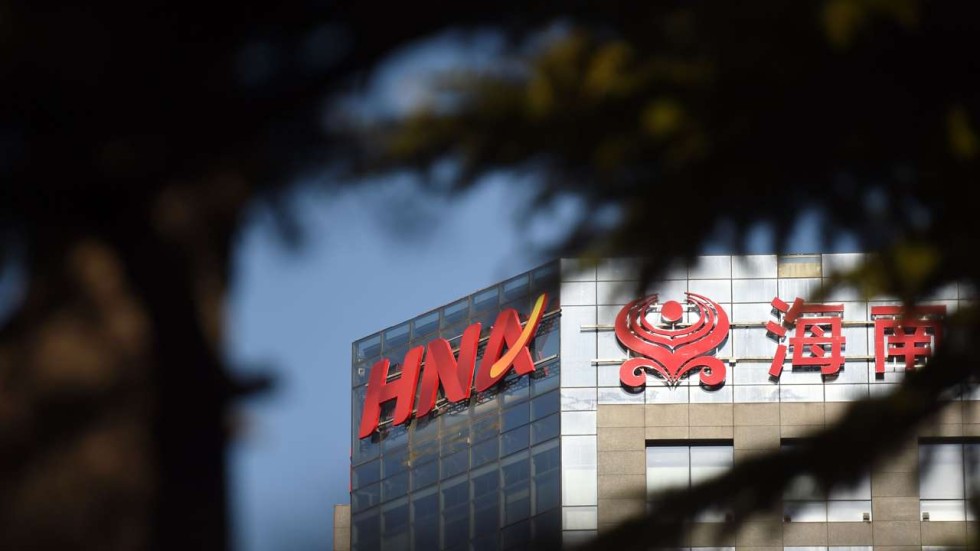
Singapore Market Update: HNA calls for shareholder meeting to vote on privatising-CWT offer

CIMB Research is keeping its “add” call on China Jinjiang Environment (CJE) with an unchanged target price of $1.10, despite lowering its earnings per share (EPS) forecasts.

HNA Holding - http://www.mmfsolutions.sg/

The research house is trimming China Jinjiang’s FY17-FY19F EPS by 1.8%, 2.2%, and 2.0%, respectively.

CIMB Share Market analyst Keith Li says this is to adjust for its new project completion schedule.

The Hong Kong-listed unit pursuing the purchase, HNA Holding Group Co., has scheduled an extraordinary general meeting for Sept 6, according to the people.

It plans to announce the date of the extraordinary general meeting to the stock exchange soon, the people said, asking not to be identified discussing private information.

CWT shares closed Friday at $2.13, an 8.6% discount to the HNA offer of $2.33 per share, a sign some investors see risks that the takeover won’t be completed as the Chinese government ramps up scrutiny of serial dealmakers.

Banks working on financing the acquisition have been seeking more information from HNA and started scrutinising its debt levels more closely, people with knowledge of the matter said in July.

HNA Holding announced last month that it expects to hold a shareholder vote on the deal between the end of August and early September.

All the pre-conditions of the acquisition must be fulfilled or waived by Sept 9 for it to proceed. A representative for CWT declined to comment, while a representative for HNA Group didn’t immediately respond to requests for comment.

Chinese regulators have been assessing the risks that HNA Group and other acquisitive companies pose to the country’s financial system.

HNA Group has announced more than US$40 billion of purchases since the beginning of 2016, according to data compiled by Bloomberg.
Penny Singapore stock to Buy 
  • Best World
  • Jiutian Chemical
  • Spackman
  • Addvalue Tech 
 These Singapore stocks are valuable for Intraday Trading ....


Saturday, 17 June 2017

How to Become an Independent Stock Trader

 Independent stock trading by www.mmfsolutions.sg

Independent stock trading is a risky venture that requires a lot of focus and attention. Squash any ideas about casually trading in your spare time. Be prepared to commit to trading like you would any other full-time job. Then, make sure you understand the difference between a trader and an investor. As a trader, you will not be interested in the intrinsic value of companies. Your goal is to make a profit and you will generally want to do it in short time frame.

1. Do not overestimate yourself. 
Doing so is the key ingredient in the recipe for disaster. Even if you think you understand the stock market, approach your goal to be a trader as if you are a novice. Invest time studying the markets, learning how and where to conduct research and learning how to recognize patterns. Also, recognize the risk. Remember that some very smart and experienced people trade stocks and lose lots of money. Be prepared for the reality that sometimes losing is part of the game.

2. Select a strategy. 
Like any business venture, being a successful independent stock trader requires some guiding structure. You can develop your strategy on your own or you can one developed by someone else. Before you make the choice, however, you need to decide what type of stock trader you are. For example, you may want to be a day trader or you may be interested in holding Singapore stocks for longer and therefore decide to be a swing trader.

3. Get high speed internet if you do not already have it.  
Stock trading is a time sensitive business. Problems such as frozen windows or slowly loading pages can be costly. For best results, DSL is recommended over cable internet service or mobile hotspot connections.

4. Consider opening a virtual account that allows you to trade fake money.
 
You can find these services free online. Using this account will allow you to get acquainted with the markets and what it is like to be an independent stock trader. Once you feel confident, open a real brokerage account online. Factors to consider when deciding what company to use include the minimum funding requirements, the commission fees and the trading platform's features. You may find that the company that held your virtual account is not the best choice for your regular use. After you have opened the account you will need to fund it. Common methods of doing so include mailing a deposit, transferring money from another account and depositing stock certificates. If you used a virtual account that differs from your brokerage account, get acquainted with the new platform before you begin trading. Make sure you understand the features, tools and costs associated with maintenance and the various types of transactions.

5. Do not feel under pressure to go all-in immediately.
 
It is best to start by only putting a portion of the money in your account to work. Select and sell stocks according to your Stock Trading strategy and decide whether you are satisfied with it. If so, increase the amount of money you deploy.

Things Needed
  • A computer
  • High speed internet
  • A brokerage account
 Original Source - http://work.chron.com/become-independent-stock-trader-21451.html

Monday, 15 May 2017

Singapore Hot Stock: Noble shares drop 12%, extending last week's fall

Shares in Noble Group fell 12 for every penny in early exchange on Monday, augmenting a week ago's slide on developing business sector worry over the standpoint for the beset products broker.
Image result for Noble Group shares
Monday's decay came after its bonds drooped and the stock dove by 53 for every penny in the last two sessions taking after a benefit cautioning which took its offers to the most minimal in 15 years.

Respectable is attempting to repair financial Advisors certainty after difficulties in the previous two years that incorporated a scrutinizing of its records by Iceberg Research and a products downturn that battered its offers and activated FICO score downsize, resource deals and gathering pledges. Respectable has remained by its records.

Singapore hot Stock of the Day:
  • SINGTEL
  • GENTING SING
  • GLOBAL LOGISTIC
  • WILMAR INTL
Earn more With  our Intraday trading signals for Short Term Trading . . . .

Get in Touch for - Stock Trading Signals , Investment Stock Picks & Stock Trading Tips . . . .

Wednesday, 10 May 2017

SGX Shares: PACC Offshore Services Holdings Update ( 2017 to Remain Weak )

 http://www.mmfsolutions.sg/
  • US$18.4m net misfortune in 1Q
  • Genuinely esteemed
  • Privatization a probability
  • Still in a Loss
PACC Offshore Services Holdings (POSH) revealed a 42% YoY fall in income to US$34.3m and a net loss of US$18.4m in 1Q17, versus net benefit of US$4.5m in 1Q16. There were inconsequential irregular things in the quarter. The greater part of the drop in income originated from the seaward convenience portion (- 65% YoY to US$10m in 1Q17) as the SSAV POSH Xanadu finished its augmented contract in Mar 2017 on decreased sanction rate and two of the light development vessels were not conveyed in the quarter. As at 31 Mar 2017, POSH had undrawn bank lines of about US$274.1m versus US$282.9m on 31 Dec 2016. Net adapting was 1.05x as at end Mar. 


Armada and Operational Updates

Out of the two LCVs that were sit in 1Q17, we comprehend that one of them initiated work in late Apr and will work for around six months, while the other is as yet searching for work. Concerning the gathering's staying two LCVs, one will go to Africa in mid May, while the last one is working in Thailand till the finish of this current year. With respect to the gathering's SSAVs, POSH Xanadu is as of now offering for work while POSH Arcadia is as of now working in Indonesia till Jun.

Work for Shell Prelude will begin for POSH Arcadia generally in Jul, for no less than 100 days. After a generally calm 1Q17, the gathering's JV POSH Terasea is likewise anticipated that would increase in 2Q17 and stay occupied for whatever is left of the year, with work booked for the INPEX Ichthys CPF and FPSO, the Shell Prelude FLNG stage, and in addition Egina FPSO unit. 

See More - Bullish market for Stocks Investment
Starting at 1Q17, the gathering had four vessels which initiated sanction with an oil major in the Middle East and the staying eight vessels will be conveyed continuously in the following seventy five percent of FY17. In all out it has 10 vessels under development, of which US$75.4m in capex are exceptional.

Look after HOLD

Keep up HOLD with S$0.335 reasonable esteem appraise (in light of 0.7x mixed FY17/18F book). With the present privatization subject in the market, there is likewise the likelihood of privatization by primary shareholder, Kuok Group.

Tuesday, 9 May 2017

MSCI Singapore Index

SGX Market Update
  • The MSCI Singapore Index ("SiMSCI Index") finished yesterday at 358.3, which is a 18 month high and a 27% recuperation from its February 2016 low. The SIMSCI Index has conveyed a 14% YTD add up to return and been among the main entertainers among key Asian files.
  • Half of the SiMSCI Index constituents have as of late revealed 1Q17 income. What's more, a huge number of profit conveyances a week ago have seen the markdown of the May SiMSCI Futures to the hidden SiMSCI Index limit by 2.0 focuses.
  • SGX SiMSCI Futures set new records in April. Normal everyday volume surged 15% month-on-month to 42,702 parts while open intrigue grew 7.2% to a notional volume of S$6.4 billion.
The MSCI Singapore Index ("SiMSCI Index") is comprised of 27 stocks, of which 26 are common constituents of the Straits Times Index ("STI"), with the rest of the SiMSCI Index constituent, Suntec REIT, on the STI Reserve list.
STI stocks that are not a piece of the SiMSCI Index are Jardine Matheson Holdings, Hongkong Land, Thai Beverage PCL and SIA Engineering. In any case, the SiMSCI Index right now keeps up an altogether high 98% relationship to the STI, which is imperative for portfolio supporting as the SiMSCI Index is the basic record for the SGX MSCI Singapore Index Futures ("SiMSCI Futures").

Cost of Carry

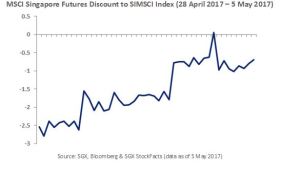
As the SiMSCI Index shut Monday at 358.3, the SiMSCI Futures were exchanging at 357.95, a rebate of 0.35 focuses. This rebate has limit essentially over the previous week as 33% of the SiMSCI constituents went ex-profit. On 28 April 2017, May SiMSCI Futures opened at 346.95 and were exchanging at 347.1 as the basic SIMSCI Index opened at 349.78, which implied that the Futures were exchanging at a 2.68 guide markdown toward the basic SIMSCI Index. This markdown limited fundamentally a week ago because of a diminishment in the cost of conveying SiMSCI Futures.
SGX Market Update
While SiMSCI Futures depend on the basic SiMSCI Index, the SiMSCI Futures cost must consider loan fees and profits. The higher the profits, the more noteworthy the rebate of the SiMSCI Futures to the fundamental SiMSCI Index. This is essentially in light of the fact that the basic SiMSCI stocks pay profits, while the SiMSCI Futures don't disperse profits. Subsequently, reasonable and proficient valuing implies that a financial specialist settling on a choice amongst fates and stocks ought to pay less for the fates if the stocks convey the advantage of profit returns.
SGX Market update
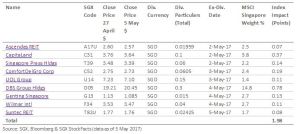
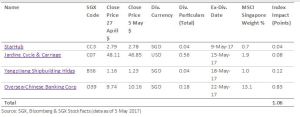
SiMSCI Index stocks that went ex-profit a week ago are tabled beneath. Mulling over characteristic SiMSCI Index weights (which are refresh day by day here) the ex-profit sums related with the nine constituents, represented as much as 2.0 purposes of the markdown of SiMSCI Futures to the hidden SiMSCI Index.
SGX Market Update
As the ex-profit dates and disseminations have passed, the SiMSCI Futures 2.0 point rebate does not have any significant bearing anymore. However as tabled beneath, there are more ex-profits ahead in the time of May. As tabled underneath, there is still ex-profits equal to 1.1 focuses to be conveyed in May.
On the opposite side of the cost of conveying in prospects, fates are utilized. This implies full subsidizes are not required to keep up fates positions, which is a money related advantage of holding fates positions rather than the fundamental stocks. With 12M SGD Interest Rates are as of now at 1.38%, the financing cost effect is a 0.1% premium to the May SiMSCI Futures over the hidden SiMSCI Index over the 21 or so days until the May contract terminates. As the profit effect is more prominent than the loan fee affect, the prospects will be hypothetically evaluated at a markdown.
Cooperation Records For SIMSCI Futures
Late cooperation records demonstrate the SiMSCI Futures has kept up solid enthusiasm among worldwide financial specialists. The quarterly income declaration season gave a further lift for expanded exchanging and arbitrage openings in deciding the reasonable estimation of the fates in the wake of evaluating in the profit appropriation.
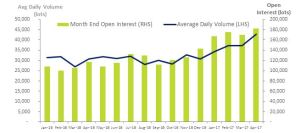
SiMSCI Futures normal day by day volume surged by 15% month-on-month to another month to month record of 42,702 contracts in April 2017. Correspondingly, open intrigue climbed consistently by 7.2% to 182,017 contracts (identical to a notional volume of S$6.4 billion), obscuring the past record of 175,472 contracts achieved in February 2017. Both volume and open intrigue additionally accomplished new single day records of 237,052 contracts and 217,901 contracts separately on 25 April 2017.
SiMSCI Futures Participation (Open Interest & Volume)
SGX Market Update
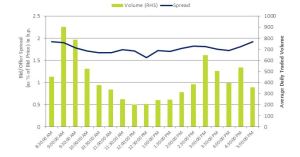
Liquidity of SiMSCI Futures has likewise enhanced as volume grabbed in the principal quarter of 2017. The normal offer approach spread for the front-month SiMSCI Futures contract has limited from 2.19 premise points(bps) in Dec 2016 to 1.76 bps in March 2017.
With more than 18 hours of exchanging crosswise over significant time zones, worldwide financial specialists can make utilization of both the standard T session which keeps running from 8.30am to 5.15pm (Singapore time), and the T+1 session which keeps running from 5.40pm to 4.45am (Singapore time) to fence against instability amid Asian, European and US time zones.
SiMSCI Futures Day Session Bid/Offer Spread & Volume (March 2017)
SGX Market Update
The fundamental SiMSCI Index finished yesterday at 358.3, which is a 18 month high and a 27% recuperation from its February 2016 low. The Index has likewise conveyed a 14% YTD add up to return and been among the main entertainers among key Asian lists.

Singapore Hot Stock of the day:

  • DBS
  • AUSGROUP
  • OCBC BANK
  • ALLIANCE MINERAL
So Earn More With our Intraday Stock Signals